The Messiah Dajjal Has Secretly Started Work
HARUN YAHYA
It is revealed in a great many reliable hadith that the Messiah Dajjal (Antichrist) will appear in the End Times, the final age before the Day of Judgment, turn people away from religious moral values, and wreak great confusion and oppression on Earth.
The Dajjal wishes to depict his own twisted ideas to Christians as true and legitimate by causing them to ignore the teachings of the Gospels. If Christians who are keenly awaiting the coming of the Messiah, especially the Evangelicals, are deceived by the Dajjal's falsehoods and follow in his path, then they will feel terrible shame and regret because of the slaughter they engaged in when Prophet 'Isa (as) finally comes.
In one of his hadith our Prophet (saas) has drawn attention to the terrible scale of the strife of the Dajjal in the words "Since the birth of Adam (as) till the advent of the Judgment Day there is no fitnah (tribulation) much greater than that of Dajjal,"
(1) and warned all people against this peril. In another hadith he indicates that the strife of the Dajjal is a grave danger not only for Muslims but for all people in the words "Every prophet came to warn his nation of the deception of the Dajjal."
(2) It would seem from the fact that the portents of the appearance of the Dajjal related by our Prophet (saas) in the hadith have one by one come to pass that the Messiah Dajjal has already appeared. A great many events experienced on Earth are in complete agreement with the information provided by our Prophet (saas) and Islamic scholars regarding the time the Messiah Dajjal will appear and the deeds he will perform. The great Islamic scholar Bediuzzaman Said Nursi has reported that the power and rule of the Dajjal are based on violence and oppression in the words "...The Dajjal appears to have greater dominion than they deserve, acquired through great oppression and great cruelty and great violence and brutality."
(3) The increasing violence, anarchy and chaos, the slaughter and torture, and state and organizational terrorist acts in recent times all show that the Dajjal is at work and is directing all of these.
In his hadith our Prophet (saas) has reported that the Dajjal will resort to all means to turn people away from the path of goodness and will bring large masses of people under his influence by means of deception and cheating. He has stated that in this way the Dajjal will lead people as he wishes in the hadith "The Dajjal has many followers. Many people will line up alongside him."
(4)In order to achieve these aims the Dajjal will seek to deceive believers just as much as he will those who have chosen denial. It is also revealed in hadith that with the propaganda and tactics he employs, the Dajjal will succeed in deceiving many people whose faith is weak, and will thus gather support:
Whoever hears about the Dajjal should keep away from him. By Allah! One will come to him and he will think that he is a believer, but he will follow him [Dajjal] on account of the doubts that he will raise in his mind.
(5)When you hear that the Dajjal has appeared, flee him. Because a person may go to his side while yet intending to deny him, but will remain and follow him. That is because there are many things with the Dajjal that fill the heart with misgivings.
(6)It is indicated in the hadith of our Prophet (saas) that to that end the Dajjal will approach the members of the three revealed religions, Jews, Christians and Muslims, with different methods, and will seek to wreak terrible strife and corruption by turning them against one another. It is revealed in hadith that as a result of this strife of the Dajjal's, the world will become the stage for a great war, that blood will be shed and the numbers of dead will rise dramatically. It is reported that nowhere will be beyond the Dajjal's sights:
[At that time] there will be much tribulation, confusion and disorder, and people will kill one another. People will take their own lives and disasters will enfold the earth. At such a troubled time ... the accursed Dajjal ... will appear.
(7)... The Dajjal will emerge from a rocky place, and will swiftly cause violent mischief on the right and on the left [in other words by sending armies to both sides].
(8)There is no city which will not be vanquished by the armies of the Dajjal.
(9)In order to depict anarchy, terror, violence, war and bloodshed as supposedly legitimate, the Dajjal seeks to deceive some believers with the falsehood that these disasters must inevitably take place in the End Times. According to the Dajjal's strategy, in order for the glad tidings imparted regarding the End Times to take place, civilizations must first turn against one another, and there must be a terrible war. According to this error, before the appearance of the Messiah, who is expected in the End Times, a terrible battle known as Armageddon must take place, between the Jews and some Christians who support them on the one hand, and Muslims and Catholics on the other. According to the indoctrination of the Dajjal, "there must be a period of disaster lasting seven years; Jews and other believers must be oppressed during that period; and two-thirds of Jews must die in the battle of Armageddon and the lands of Israel must be devastated." By means of a series of figurative, but groundless interpretations of holy scriptures, the Dajjal seeks to make Christians and Jews believe that the Messiah can only come to earth once all these conditions have been fulfilled. According to this belief, inculcated in Christians by the Dajjal, the Jews will win that battle under the leadership of Prophet 'Isa (as), will follow him, and will return to Christianity.
The Dajjal seeks to lead a number of Christian groups in the direction of confusion by making them believe that a number of preconditions need to be met if Prophet 'Isa (as) is to return to earth. The fact is, however, that there is no confusion here at all. Dajjalism is the absence of belief in Allah. The presence of belief in Allah is Messiahhood. The coming of Prophet 'Isa (as) is a miracle from Allah. However, this is not a matter that requires confusion beforehand. Throughout history Allah has supported prophets with a great many miracles. Allah shows people a great many miracles of creation at every moment of their lives. Features such as the perfect equilibrium in the universe, the extraordinarily complex structure in the cell, the marvels in animals and plants, and the flawless functioning of the human body are all great miracles. Allah creates many beauties so that believers may perfect their faith. The coming of Prophet 'Isa (as) is a beautiful event created by Allah for joy of faith, and is a gift of faith. When the time appointed by Allah comes, He will show Prophet 'Isa (as) to all mankind. Involving confusion and many preconditions in such a beautiful event must be seen as part of the Dajjal's devilish plan, and people must be on their guard against that snare.
The Messiah Dajjal Wants Chaos in the Middle East…
The Messiah Dajjal seeks to portray chaos and slaughter as necessary developments in order to make people believe in his system, and for that reason he encourages even innocent children to be murdered.
In this way the Dajjal is trying to make Christians to believe that before the coming of Prophet 'Isa (as) there must be war, chaos and a climate of anarchy on earth. He approves of the idea that the Iraq war assumed a key role in these portents of the Last Day they expect to come about. He causes those people who fall under his spell to believe that speaking of peace before the coming of the Messiah is to go astray, to oppose the holy scriptures, and even Dajjalism. By these means he convinces them that tension in the Middle East should not be lowered.
(10) He portrays countries that are opposed to war, and peace movements, as part of the movement of the Dajjal, and intends to make sure the climate of war in the region continues so that there should never be peace there until the coming of the Messiah.
It is clear that there are a number of problems in some Middle East countries, stemming from lack of education and the fact that a culture of democracy has not fully developed. However, the way to resolve these must never be by resorting to war and violence. It must not be forgotten that war always inflicts loss and destruction on both sides. Indeed, in the Iraq War, many innocent Iraqis are dying, losing relatives or being crippled. Similarly, a great many foreign troops in the region are also dying. The loss of these troops, each one of whom is an educated, cultured young person, is a great loss to both their families and their countries. Yet the fact is that it would be easy for both sides to come by a solution without suffering any material or spiritual losses or loss of life. If people live by the love, tolerance and justice required by the moral values commanded by Allah, then all problems can be resolved by peaceful means, and compromise can easily be achieved.
A great many regions of the Middle East are sacred for Christians, Jews and Muslims. These areas are in any case the lands of the forefathers of Christians and Jews. All the prophets loved and respected by Muslims lived in these lands and communicated their message there. These lands, which are most valuable and sacred to all of us, are very wide. Members of the three revealed religions must be able to live as they wish, be free to perform their religious observances, engage in trade and leave in peace and security on these lands. The underground resources possessed by the region, especially oil, can be made use of in such a way that everyone can benefit from them equally. An atmosphere of peace and security is essential for this. What the region needs is for societies to progress in terms of art, medicine and science, for an environment in which fundamental human rights and individual rights are protected to be established, and for a full concept of democracy to be installed. In connection with this it is also important that economic development should be ensured. However, it is a great loss to spend resources that could be set aside for these things on military expenses and weaponry instead. To that end, sincere believers must join forces, and existing means must be used to establish that alliance rather than on waging war.
Problems such as these in the region stem from the fact that people fail to live fully by religious moral values, and from the influence of such ideologies as materialism and atheism, supported by the Dajjal. This, of course, is not a problem limited to the Middle East alone. Moral degeneration caused by people having turned away from religious moral values, serial killings and perversions of various kinds can be seen in a great many regions of the world. What sincere believers need to do is to make genuine endeavors for these practices outside religious moral values to be eliminated. Naturally, the Dajjal will seek to spread this situation all over the world, and will emerge with various tactics and cunning plans in order for the environment of war and terror to persist.
Christians Must Be on Their Guard against the Messiah Dajjal's Snares
Christians and Jews must be on their guard against all these snares of the Dajjal, because the Dajjal will seek to depict all these as religious stipulations. The Dajjal plots against Christians who sincerely believe in the Gospels and tries to attract them to a perverted ideology that actually conflicts with their own sacred texts. He wants to portray his own twisted ideas as right and legitimate by causing Christians to ignore the teachings of the Gospels. In fact, he is laying enormous snares by emerging in the name of Allah and depicting the truth as superstition, and superstition as the truth. He causes them to believe that they are acting in the name of religion and good, and encourages them towards evil by using the name of Allah. In the Qur'an, people are warned against this method employed by the Dajjal: "Mankind! Allah's promise is true. Do not let the life of this world delude you and do not let the Deluder delude you about Allah" (Surah Fatir: 5). It is also reported in the hadith of our Prophet (saas) that the Dajjal will deceive people by depicting good as evil, and evil as good:
He will also have Paradise and Hell with him. Though his Paradise will appear as Jannah [Paradise], in reality it will be Hell, and likewise, though his Hell will appear like Jahannam [Hell], in reality it will be Paradise.
(11)Then the Dajjal will come forth accompanied by a river and fire. He who falls into his fire will certainly receive his reward, and have his load taken off him, but he who falls into his river will have his load retained and his reward taken off him.
(12)Narrated by Hudhaifa;The Prophet said about Ad-Dajjal that he would have water and fire with him: (what would seem to be) fire, would be cold water and (what would seem to be) water, would be fire.
(13)All the preconditions set out by the Dajjal for the coming of the Messiah, allegedly based on holy scriptures, actually consist of a trap constructed by the Dajjal so that evil should rule the world. As is revealed in the description in the hadith, "His Hell is Paradise, and his Paradise Hell," the Dajjal seeks to portray good as evil and evil as good by distorting everything.
The Dajjal has emerged before Christians at a most unexpected time and employing deceptive tactics they never expected. Approaching them by using the name of Allah and basing his desires on sacred justifications, he has deceived a number of Christians who were expecting his coming under very different conditions. The Dajjal is trying to bring part of the Christian community under his sway by depicting love, peace and security on earth as being part of the Dajjal system, and his own ideological system as a requirement of the religion in which they believe. Telling them to "Believe in Prophet 'Isa" or that "This is commanded in the Gospels," he approaches them by portraying what he wants them to do as perfectly legitimate. His actual target is to establish large communities whom he can direct as he wishes in the struggle against Prophet 'Isa (as), who will return to earth in the End Times. In this way he intends to inflict terrible chaos, confusion, corruption and destruction on the world by turning communities against one another.
He portrays peace, liberation and security, and the achievement of peace in the Middle East as Dajjal-like movement engaged in opposition to holy scriptures; bloodshed, the ruthless killing of innocent men, women and children, and the spread of pitiless savagery over the region are all portrayed as a so-called religious observance. He portrays Catholics, who believe in the same scriptures as them and who recognize Prophet 'Isa (as) as their prophet, and who perform the same acts of worship, as enemies who need to be eliminated. Similarly, he portrays Muslims, who like them believe in Allah, love and respect the same prophets, possess the same moral principles, and who are awaiting the coming of Prophet 'Isa (as) with the same excitement, as a community needing to be combated.
The fact is, however, that Christians, Jews and Muslims are not one another's enemies; on the contrary, they are one another's allies against the atheism supported by the Dajjal. Christians, Jews and Muslims believe in Allah in the same way, and love and respect the same prophets. Prophet Ibrahim (as), Prophet Ishmael (as), Prophet Ishaq (as), Prophet Ya'qub (as), Prophet Yusuf (as), Prophet Musa (as) or Prophet Dawud (as) are just as important to Muslims as they are to Jews. In the same way, Prophet 'Isa (as) is just as valuable and sacred to Muslims as he is to Christians. The entire Islamic world has been announcing the glad tidings of this holy individual's return to earth for the last 1,400 years and preparing for this historic event with the greatest enthusiasm. In addition, the lands lived on by Jews and Muslims, and where they serve Allah, are just as sacred to Muslims as they are to Jews. That being the case, there can be no legitimate reason for a climate of war, chaos and anarchy, or for bloodshed on lands that are sacred to members of all three revealed religions. This subject needs to be considered in a most rational manner: Why should living in peace and security be Dajjalism? Why should centuries of fear and savagery, and catastrophes, be necessary in order for the Messiah to appear? Why should there be no peace, and why should war be sought to be continued, until the coming of the Messiah? Why should two-thirds of Jews have to die? Why should people who believe in the same religion wage war on one another? Why should Catholics and Muslims be the enemies of Jews and other Christians? Why should innocent Christian, or Jewish or Muslim children be killed for nothing?
There is no legitimate reason for any of these things. The Dajjal is trying to portray peace, liberation, brotherhood, love, compassion and affection as actions belonging to the Dajjal. In this way, he is trying to achieve his aims by turning Jews, Christians and Muslims against one another.
It is a great blessing that Christians are devout, fear Allah, feel a sincere love and devotion for the prophets and Prophet 'Isa (as), and engage in the preparations for his second coming. Yet it is most important that they should not fall into the Dajjal's trap. Each one of the conditions he is trying to make Christians blindly believe in, and which he suggests have to be fulfilled in order for Prophet 'Isa (as) to return, are part of a trap that the Dajjal has prepared in order to inflict disappointment and corruption on mankind. His aim is thus to establish a system which will literally lock in terror, violence and anarchy, by bringing a large mass of people under his spell.
All Christians need to see that this is a tactic being employed by the Dajjal, and to respond to this grave danger by keeping to the path indicated by Allah, in a manner appropriate to religious moral values. All the prophets have told the communities among whom they lived that the Dajjal would deceive people by such methods as these. Indeed, his most devilish method of deception will be to seek to influence sincere believers and turn them against one another by appearing in the name of Allah and religion. The Dajjal needs to be evaluated in the light of this information, and people need to be on their guard against such snares laid by him as these.
This Indoctrination by the Dajjal Conflicts with the Torah and the Gospel
The indoctrination carried out by the Dajjal by imputing false interpretations of the Old Testament, suggesting that there needs to be war between Muslims and Catholics, and other Christians and Jews, that the climate of violence and tension needs to be maintained, and that peace has to be prevented, are in complete contradiction of both the New Testament and the Old. This distorted analysis is the complete moral antithesis of the moral values taught to Christians by Prophet 'Isa (as). Christianity is based on love, peace and tolerance. It is written in the Gospel of Matthew that Prophet 'Isa (as) told his disciples to "Love your enemies, bless them that curse you..."(Matthew: 5:44). In the Gospel of Luke it is revealed that he said, "If someone strikes you on one cheek, turn to him the other also…" (Luke: 6:29). Nowhere in the New Testament are there any provisions legitimizing violence. There is very definitely no room for any idea favoring the killing of innocent people. Christianity is a religion of love and peace. In the Gospels, Christians are commanded to love even their enemies, to do good to all mankind, and to respond to evil with good. When one looks at the Gospels, one sees that Prophet 'Isa (as) always recommended love, peace and friendship:
"Make sure that nobody pays back wrong for wrong, but always try to be kind to each other and to everyone else." (1 Thessalonians 5: 15)
Remind them … to obey … showing all humility to all men. (Paul's Epistle to Titus 3: 1-2)
Be kindly affectionate to one another with brotherly love, in honour giving preference to one another. (Romans 12: 10)
Another matter emphasized in Gospel statements is the eradication of discrimination, conflict and disputes, and for peace to be maintained by people uniting around a single idea:
"…all of you agree with one another so that there may be no divisions among you and that you may be perfectly united in mind and thought." (Corinthians 1: 10)
If it is possible, as far as it depends on you, live at peace with everyone. Do not take revenge, my friends… (Romans 12: 18-19)
"You have heard that it was said, 'Love your neighbor and hate your enemy.' But I tell you: Love your enemies and pray for those who persecute you. (Matthew 5: 43-44)
The Dajjal's indoctrination encouraging violence also conflicts with the Old Testament, on which some Christians base their beliefs regarding signs of the Last Day. Stipulations in the Torah include to "stop one's ears against plots of murder" and to "shut one's eyes against contemplating evil" (Isaiah 33:15). Christians and Jews who sincerely believe in Allah need to live by the moral values which they adhere to in so many spheres with regard to these provisions in the Bible, and to support peace. Some quotations from the Torah in which violence and oppression are condemned and peace, love, compassion and proper moral values lauded read as follows:
Do not pervert justice… Do not do anything that endangers your neighbour's life... Do not seek revenge or bear a grudge against one of your people, but love your neighbour as yourself… (Leviticus 19:15-18)
"Seek good, not evil, that you may live. Then the LORD Allah Almighty will be with you, just as you say He is. Hate evil, love good; maintain justice in the courts..." (Amos 5:14-15)
Another provision in the Torah is that blood should not be shed and that the lands of the righteous should not be attacked:
Do this so that innocent blood will not be shed in your land, which the LORD your God is giving you as your inheritance, and so that you will not be guilty of bloodshed. (Deuteronomy 19:10)
Do not lie in wait like an outlaw against a righteous man's house, do not raid his dwelling place… Do not gloat when your enemy falls; when he stumbles, do not let your heart rejoice, or the LORD will see and disapprove… (Proverbs 24:15-18)
Although the texts of the Gospel and the Torah were later corrupted, they still include some true provisions compatible with the Qur'an. Devout Christians and Jews must behave in the light of these statements in the Old and New Testaments. Otherwise, as well as contravening their own sacred texts, they need to see that they will actually be serving the Dajjal. It must not be forgotten that the Dajjal's initiatives to shed blood in the Middle East and the rest of the world can only be prevented by the defense of proper moral values.
Muslims Must Also Be on Their Guard against the Wiles of the Dajjal
The Dajjal is trying to use another stratagem against Muslims, similar to that he wishes to employ against Christians. He wishes to bring Muslims under his control in order to create terrible strife and wickedness on earth. By deceiving Muslims, too, he seeks to encourage them to resort to violence in response to the violence aimed at them, and thus quench the devil's thirst for bloodshed. On the other hand, he is also striving to turn Muslims against one another by encouraging terror amongst them. In this way he aims to increase the climate of fear and terror, and by shedding the blood of the innocent to turn the world into a place of strife where his own moral values can prevail.
The great Islamic scholar Bediuzzaman Said Nursi has warned all Muslims against this peril, and said that the Dajjal would put pressure on the Islamic world and inflict difficult and hard times on devout Muslims:
According to a noble Hadith of the Prophet (saas), noxious and awesome persons like Sufyan and the Dajjal will come to rule over the godless at the end of time, and exploiting the greed, discord and hatred amongst the Muslims and mankind, they will need only a small force to reduce humanity to anarchy and the vast world of Islam to slavery.
(14)Devout Muslims should be aware of this danger and not fall into the Dajjal's trap. As a requirement of the verse "Allah loves those who fight in His Way in ranks like well-built walls" (Surat as-Saff: 4), Muslims must act in a spirit of unshakable unity and union. They must take the moral values of our Prophet (saas), who always sought the path of understanding even with the idolaters, as their role model; they must scrupulously avoid disputes and disagreement. In fact, our Prophet (saas) has warned Muslims against such a danger by reminding them that in the event that believers turn against one another they may fall under the influence of the Dajjal:
In those days believers whose relations between one another are defective will be unable to escape being the target of the Dajjal.
(15)It can be seen from these words of our Prophet (saas) that believers who wish to be protected from the strife of the Dajjal must act in the awareness that all Muslims are brothers. It has been revealed in the Qur'an that the faithful must support one another in solidarity, otherwise there will be great corruption and chaos on earth:
Those who disbelieve are the friends and protectors of one another. If you do not act in this way, there will be turmoil in the land and great corruption. (Surat al-Anfal: 73)
Muslims must also behave towards Christians and Jews in the manner required by the moral values of the Qur'an, in the same way as they must amongst themselves, and must be on their guard against the wiles of the Dajjal in that regard too. In many verses of the Qur'an Allah has revealed the importance of proper moral values, goodness, and responding to evil with good, and has commanded Muslims to treat Jews and Christians, in other words the People of the Book, with good intentions and tolerance. In the Qur'an our Lord commands people to rule with justice, with no discrimination between people, to protect people's rights, to have no allowance for oppression, to support the oppressed against the oppressor, and to help those in need. This concept of justice requires the rights of both sides to be protected when a decision has to be reached, a multi-sided consideration, unprejudiced thought, neutrality, uprightness, honesty, tolerance, compassion and affection. Muslims must always behave in accordance with the verses of the Qur'an against the Dajjal's deceptions of this kind, with patience, submission to Allah, and moderation, and must respond with love and affection. Allah has revealed in the Qur'an that when believers encounter evil they must respond with goodness:
A good action and a bad action are not the same. Repel the bad with something better and, if there is enmity between you and someone else, he will be like a bosom friend. (Surah Fussilat: 34)
One of the finest models on this subject is the moral values displayed by our Prophet (saas). Prophet Muhammad (saas) always behaved most justly and compassionately towards Jews and Christians. He wanted an environment based on love and compromise to be established between Muslims and members of the other revealed religions. In the early years of Islam, some Muslims who suffered oppression at the hands of the polytheists of Mecca lived in friendship and peace with Christians by sheltering with the Christian king of Ethiopia, Negus (or al-Najashi). Believers who migrated to Medina with our Prophet (saas) developed a model of living with the Jews in Medina that constitutes a model for all subsequent generations. During the spread of Islam, the tolerance shown to Jewish and Christian communities in Arabia went down in history as an important example of Muslims' tolerance and justice towards the People of the Book.
Under the provision of the Constitution of Medina that "The Jews of Banu Awf [non-Muslim minorities] are a community along with the believers. To the Jews their religion, and to the Muslim their religion," the foundations of the tolerance that Muslims showed towards Jewish traditions and belief were again laid in the time of our Prophet (saas).
Another example of these moral values of Muslims was experienced at the time of the Ottoman Empire. At a time when the world was full of intolerance and oppression, the Ottoman Empire went down in history for the great tolerance it displayed towards Jewish communities. Throughout history these Muslim moral values have resulted in Jews sheltering in Islamic lands at various times when they were suffering trouble and difficulty. The Ottoman Empire opened its doors to the Jews who were unjustly expelled from Spain, and the Ottomans sheltered thousands of Jews who had been exiled from their lands. Jews and Muslims lived for centuries in peace and security in Muslim lands. Jewish subjects of the Ottoman Empire were always grateful for the tolerance shown them by the Sublime Porte.
The same thing applied to Christians under Ottoman rule. Christians, too, found tolerance, peace and freedom in Ottoman lands. In the Middle East, which has been in a state of chaos and conflict since the first half of the 20th century, a climate of peace and security was established that lasted throughout the centuries of Ottoman rule. Although Christians and Jews did not acknowledge each other's religions, they enjoyed dialogue and compromise in this tolerant environment established by the Ottoman administration. Under Ottoman sovereignty, Jews worshipped in their synagogues, Christians in their churches and Muslims in their mosques, and members of the three religions lived alongside one another in peace.
The proper moral values, tolerance, and peaceful understanding demonstrated towards the People of the Book by our Prophet (saas) and the Ottoman administration must be a role model for all Muslims. As revealed by Allah in the verse "Only argue with the People of the Book in the kindest way-except in the case of those of them who do wrong-saying, 'We believe in what has been sent down to us and what was sent down to you. Our Allah and your Allah are one and we submit to Him,'" (Surat al-'Ankabut: 46) no concession must be made in a struggle to be waged "in the kindest way." On the contrary, it must not be forgotten that a climate of strife and chaos will emerge as the Dajjal wishes. Muslims must approach the People of the Book with respect, love and understanding, based on these foundations, and with the moral values to which they adhere must transmit the call to "unite in a common proposition" in the kindest manner possible:
Say, "People of the Book! Come to a proposition which is the same for us and you-that we should worship none but Allah and not associate any partners with Him and not take one another as lords besides Allah." If they turn away, say: "Bear witness that we are Muslims." (Surah Al 'Imran: 64)
When people act in the light of this spirit of love and tolerance imparted by Qur'anic moral values, the Dajjal's stratagem aimed at turning civilizations against one another and making the world the scene of bloodshed and war will, by the will of Allah, be thwarted.
The False 'Isa: The Messiah Dajjal
As has been described throughout the course of this discussion, the Dajjal is indoctrinating Christian communities regarding the occurrence of various false portents of the Last Day for the appearance of the Messiah, and is encouraging them to bring these false portents to pass. Once these conditions have been met, the Dajjal will then make claims regarding the "False Messiah" as a requirement of the false order he will have established. Many false Messiahs will appear before the coming of Prophet 'Isa (as), but the Messiah Dajjal will be the most violent of these. According to the indications in the hadith, various groups among Christians and Jews whom he brings under his influence will organise these phenomena and will portray the Dajjal to people as Prophet 'Isa (as). It is revealed in the hadith of our Prophet (saas) that the Dajjal will first claim "prophethood" and then "so-called divinity" (Allah is truly beyond what they ascribe to Him):
When the Dajjal appears ... everyone will imagine him to be a genuine guide and will flock to his side, and he will continue his work in the same way when he comes to Kufa, and will lay claim to prophethood ... Rational people who see this will depart from him ... Later still, he will lay claim to divine status, and will even say "I am Allah."
(16)He will start by saying that he is a Prophet, but there will be no Prophet after me. Then he will say, "I am your Lord," but you will never see your Lord until you die.
(17)… They [the devils] will say to him [the Dajjal], "We are your helpers and under your command." He will then say to them, "Hurry and tell people that I am their Allah…"
(18)Imam Sharani reported that the Dajjal's claim to divine status would bring nations under his control:
The Dajjal will come to the people and invite them (to a wrong religion); they will affirm their faith in him and respond to him.
(19)It can be seen from all this information that the Dajjal will first portray himself to people as a guide, then will claim to be the Messiah, and then declare himself to be divine (Allah is truly beyond what they ascribe to Him). In order to convince large masses of people, the Dajjal will make use of technological means and use the most advanced special illusive effects and techniques of hypnosis. Bediuzzaman Said Nursi has spoken of these methods to which the Dajjal will resort:
The Dajjal possesses hypnotic properties along the lines of spiritualism ... This unbeliever whose only aim is this world attacks spiritual values with a brazenness and courage stemming from absolute unbelief. People who do not know the true state of affairs will regard this as extraordinary power and courage.
(20)Elsewhere, Bediuzzaman describes the trickery the Dajjal will use to deceive people:
The worst of these who will lead them, the Dajjal, possesses marvels linked to phenomena of spiritualism and magnetism [with such phenomena as hypnotism and contact with the jinns], and will go still further, and will declare his own divinity [Allah is truly beyond what they ascribe to Him], conceiving of a kind of divinity for his forced and false rule...
(21)As stated by Bediuzzaman, the Dajjal will be a mastery of such deceptions as hypnotism and illusion, and will perform fake miracles by means of technological special effects, thus depicting himself as Prophet 'Isa (as). In the hadith of our Prophet (saas) it is described how he will influence people by means of these fake miracles:
He [Dajjal] will say to a Bedouin, "What do you think if I bring your father and mother back to life for you? Will you bear witness that I am your Lord?" The Bedouin will say; "Yes," so two devils will assume the appearance of his father and mother…
(22)At this the Dajjal will ask his villainous people "If I now kill this man and then resurrect him, will you have any doubts about my claim to be divine?"
(23)He will be given power over one person, whom he will kill and cut in two with a saw. Then he will say, "Look at this slave of mine, now I will resurrect him..."
(24)According to the hadith, in claiming a false divine status for himself the Dajjal will call people back from the grave by means of trickery, and present himself as if he resurrected the dead, putting on an unfamiliar and astonishing show for the masses. Christians will think that all these are the miracles they believe Prophet 'Isa (as) would perform, and will thus be easily convinced of the alleged divinity of the Dajjal. Many people will be affected by these exaggerated displays staged by the Dajjal, and will conclude that he is the real Prophet 'Isa (as).
All these ruses of the Dajjal's described so far are compatible with the information about the Dajjal provided in the hadith of our Prophet (saas), in commentaries by Islamic scholars, and in the sacred texts of other religions. It is evident in the light of that information that the activities he organizes are Dajjal-like ones. Therefore, Christians, Jews and Muslims must act in the awareness of this and be careful not to fall victim to the Dajjal's ruses.
The Dajjal Will Continue to Deceive People until the Coming of Prophet 'Isa (as)
The Dajjal is attempting to deceive Christians in the name of preparing the groundwork for the coming of the Messiah. Making preparations for the coming of Prophet 'Isa (as) is of course a great service and is an expression of very pleasing love and respect shown to the prophet. However, the Dajjal aims to make the people he takes under his spell do this by very different means, depicting oppression and bloodshed as legitimate. In fact, according to the indications in the hadith, the Dajjal's endeavors in this regard will not come to an end until Prophet 'Isa (as) returns to earth, and he will continue to deceive the people he gathers round him in the name of service to Allah and to religion, and loyalty to Prophet 'Isa (as). Neither the unmasking of these wiles of the Dajjal, nor warning people who fall under his spell and incite terror, violence, war and bloodshed will be enough to halt the Dajjal. Some Christians will pay no heed to these warnings, because of the Dajjal making the claims exactly as they are expecting, his appearing at the expected time, and his performing fake marvels that they imagine to be miracles. The strife of the Dajjal, the number of his supporters and the extent of their Dajjal-like actions will increase still further (Allah knows best, of course).
However, it must not be forgotten here that these things will be experienced because they assume that form in destiny. Neither the Dajjal nor those who support him possess any power of their own. Some people think that they are preparing the necessary portents of the Last Day in order for Prophet 'Isa (as) to appear, but it is actually Allah Who is creating these. Those who are making great efforts for Prophet 'Isa (as) to come will attain the result they wish for. Prophet 'Isa (as) will return. However, his coming will be because Allah willed and appointed in destiny, not because the people in question have readied the requisite conditions in the light of their own beliefs. That is because there is no question of anyone having the power to do anything unless Allah so wishes.
In the same way, the Dajjal's portraying his own desires to one group of Christians as legitimate and directing them is also taking place because that is the destiny specified by Allah. Otherwise the Dajjal has appeared exactly in the manner described, and it can be seen from all the portents that he is indeed the Dajjal. Again, however, since that has been determined in destiny, he will succeed in deceiving certain groups from among Christians and Jews. Indeed, despite all these warnings the Dajjal will continue to deceive and plot, and those around him will fail to recognise his false countenance. This will continue to be so until the coming of Prophet 'Isa (as), and Christian communities and other people will only realize these facts with the appearance of the true Messiah.
With the Coming of the True Messiah 'Isa, the Strife of the Dajjal Will Disappear Like Salt Melting in Water
All the Dajjal's stratagems will only be thwarted with the coming of Prophet 'Isa (as). When the Dajjal sees Prophet 'Isa (as), he will dissolve away like salt in water; all his deceptions will be revealed, he will be humiliated in the public eye and will suffer a terrible defeat. It will become plain that all the fake miracles he performed in claiming to be the Messiah were mere deceptions; all his hypnotism, illusions, technological displays and mass shows will be neutralized. This defeat of the Dajjal by means of Prophet 'Isa (as) is reported in the hadith of our Prophet (saas):
When the enemy of Allah [Dajjal] see him [Prophet 'Isa], it will (disappear) just as salt dissolves in water and if he [Prophet 'Isa] were not to confront them at all, even then it would dissolve completely. Allah would kill them by his hand.
(25)The son of Mary will kill the Dajjal at the gate of Ludd.
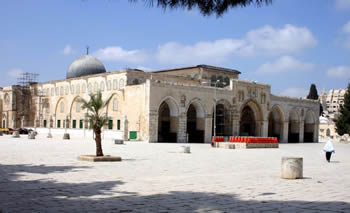
(26)As is revealed in the hadith, the place where the Dajjal will be defeated is Jerusalem. When Prophet 'Isa (as) returns to earth he will encounter the Dajjal at Beit al-Makdis (the Masjid al-Aqsa) and, again as revealed in the hadith, even the breath of Prophet 'Isa (as) will be sufficient for the strife of the Dajjal to be eliminated:
... It is impossible for any unbeliever who scents his [Prophet 'Isa'] breath not to die. The fact that the Dajjal is a liar will radiate out in waves. Dajjalism will be overthrown and his intellectual system destroyed.
(27)Every non-believer who would smell the odour of his [Prophet 'Isa'] self would die and his breath would reach as far as he would be able to see. He would then search for him [Dajjal] until he would catch hold of him at the gate of Ludd and would kill him.
(28)In the light of certain developments that are taking place today, the Dajjal has already settled in this place where he will be defeated. Certain signs show that supporters seeking to set up a false Messiah under false conditions may be hiding the Dajjal in broad facilities they have established under the Masjid al-Aqsa. These people who support the Dajjal may be trying to give the impression that he is the true Messiah by giving the site a mystical appearance (Allah knows best, of course).
The Dajjal wil remain in this temporary location until the coming of Prophet 'Isa (as), the true Messiah. By Allah's leave, however, he will be destroyed by means of Prophet 'Isa (as) before he can construct his temple there.
This situation the Dajjal will encounter is recalled in the verse "Rather We hurl the truth against falsehood and it cuts right through it and it vanishes clean away!" (Surat al-Anbiya': 18) In another verse, "Say: 'Truth has come and falsehood has vanished. Falsehood is always bound to vanish'" (Surat al-Isra': 81), it is reported that truth will always vanquish falsehood, and this shows that all the stratagems of the Dajjal will eventually be thwarted.
The Responsibility Incumbent on People with True Faith
With the coming of Prophet 'Isa (as) and the Mahdi, those paganistic beliefs and philosophies that deny the infinite might of Allah that the Dajjal seeks to have prevail on earth will be utterly defeated. When people come to live by Qur'anic moral values, the world will be freed from wars, conflicts, hostility, oppression and injustice; and an age of peace, happiness and security will dawn for mankind. Therefore, no matter which belief they have adopted, believers who are sincerely preparing for the coming of Prophet 'Isa (as) should engage in endeavors to construct the infrastructure for such an environment and strive to prevent all forms of discrimination and conflict.
Sincere Christian believers must reveal that the false portents of the Last Day that encourage war, mass slaughter and bloodshed, which the Dajjal makes people believe are obligatory, are in no way compatible with Christian teaching, which supports peace and love. They must show those people who support this idea the error of their situation, and must call them to the truth. With the efforts in this regard of Christians and Muslims possessed of common sense, the increase in tension that is being sought in many parts of the world can, by Allah's leave, be prevented. The need for this morality is recalled in the Qur'an by revealing that Christians and Jews who perform good deeds receive their recompense in the sight of Allah:
Those with faith, those who are Jews, and the Christians and Sabaeans, all who believe in Allah and the Last Day and act rightly, will have their reward with their Lord. They will feel no fear and will know no sorrow. (Surat al-Baqara: 62)
It must not be forgotten that inciting war and preventing peace, as the Dajjal encourages some Christians to do, will inflict great losses, tears and suffering on both sides. In the event that sincere believers join forces, however, the stratagems the Dajjal is using to turn the world into an arena of war will, by Allah's leave, be thwarted.
REFERENCES
1. Sahih Muslim; Muhammad ibn 'Abd al-Rasul Barzanji , Al-Isha'ah li-ashrat al-sa'ah, p. 225.2. Sahih Muslim, English translation, Kitab Al-Fitan Wa Ashrat 'As-Sa'ah, Hadith No. 7000.3. Bediuzzaman Said Nursi, Risale-i Nur Collection, Rays of Light, 4694. At-Tabrizi; Mishkat al-Masabih, 1382/1962, 3:38.25. Kanz al-Ummal, no.2057.6. Abu Dawud, 14.7. Mukhtasar Tazkirah Qurtubi, 482.8. Sunan Ibn Majah; Mukhtasar Tazkirah Qurtubi, 493-494.9. Sahih Muslim, vol. 8, 500.10. Grace Hallsell, Prophecy and Politics: Militant Evangelists on the Road to Nuclear War.11. Sahih Muslim.12. Sunan Abu Dawud, no. 4232, Narrated Hudhayfah ibn al-Yaman.13. Sahih Bukhari14. Bediuzzaman Said Nursi, Risale-i Nur Collection, The twenthy second letter; al-Hakim; Ibn hibban)15. Al-Hakim, 4:529-530.16. al-Tabarani narrated from b. Mu'tamar, the Companion of the Prophet (saas).17. Sahih Muslim; Sunan Ibn Majah, 4077.18. Sahih Muslim, al-fitan, Sahih Muslim, Kitab Al-Fitan Wa Ashrat 'As-Sa'ah (English translation), Hadith No. 7000.19. Sahih Muslim, 7015.20 Bediuzzaman Said Nursi, Risale-i Nur Collection, The Flashes.21 Bediuzzaman Said Nursi, Risale-i Nur Collection, The Letters, 55.22 Sunan Ibn Majah, 4077.23 Sahih Bukhari, vol. 15, 6981.24 Sahih Muslim, 4077.25 Sahih Muslim, 692426 Hadith at-Tirmidhi.27 Sunen Ibn Majah, 10/32.28 Sahih Muslim.



_001.jpg)
.jpg)


.jpg)